Lay Your Drawing Over the Reference
When I draw from a reference, I check the drawing the same way I make it: eyes going back and forth between the photo and my drawing. Is the head about that big? Does the arm leave the shoulder at about that angle? Most of the time the answer I give myself is close enough, and I keep going. Then afterwards I sometimes lay the finished drawing on top of the reference, and the answer is often different. The head is usually smaller than I thought. The legs are too short. The whole figure leans a few degrees more than the one in the photo. By then the attempt is over, and all I can do is note it for next time.
I wanted a quick and easy check during the drawing, while the lines could still move and a correction wouldn't require changing the whole image. I've seen teaching material do the same thing in painting programs: drop the drawing's opacity, lay it over the reference, and see how close it really came. I knew the method but rarely used it, partly because in a painting program it takes some work: switch to the right layer, get the opacity right, then change everything back. That's the check I wanted to be able to do inside my own practice sessions, without the extra steps.
It's not a new idea
Laying one image on top of the other isn't even a digital-age trick. In his notebooks, Leonardo da Vinci describes the same check with the materials he had:
When you have drawn the same thing so many times that you think you know it by heart, test it by drawing it without the model; but have the model traced on flat thin glass and lay this on the drawing you have made without the model, and note carefully where the tracing does not coincide with your drawing, and where you find you have gone wrong; and bear in mind not to repeat the same mistakes. Then return to the model, and draw the part in which you were wrong again and again till you have it well in your mind.
(The Notebooks of Leonardo da Vinci, §531, on Wikisource)
He wrote it as a test for drawing from memory, but the check itself carries over to drawing from observation: stop estimating whether the two images agree, and put them where you can see whether they agree. The last step is worth noticing too. He doesn't say to fix the drawing. He says to go back to the model and draw the part you got wrong again and again.
Why the glance lets so much through
One of the better-known studies on why drawings from observation go wrong is Cohen and Bennett's 1997 paper, Why can't most people draw what they see? They laid out four possible sources of error: misperceiving the subject, making poor decisions about what to put down, motor skill, and misperceiving your own drawing. Their tests found the hand to be a very minor source and misjudging your own drawing not to be a source at all. What was left, in their reading, was the first one: most of the error comes from how the subject itself is seen. (Cohen & Bennett, 1997, PDF)
The study didn't test overlays, so this next part is my own reading of it. If the mistake comes from how I saw the reference, then checking by looking at the reference again uses the same seeing that made the mistake. I measure the arm against the same wrong impression of the arm, and it agrees with itself. The overlay asks a much simpler question — do these two lines sit in the same place or not — and answering it leans far less on my impression of the arm. I still have to line the two up and decide which differences matter, which is most of what the next section is about.
How I practice with it
Commit before checking. I draw until I've actually decided where things go, then look. I don't have any evidence on whether checking constantly, even for small corrections, is a good or a bad thing, and I'm not sure where a change stops being small. But I imagine that checking after every tiny change would break the flow of drawing, and I don't think that's how it should be used.
Try to figure it out first. Before switching the overlay on, I try to figure out where the drawing is off. Sometimes I can name it: the head is off, or the look on the face isn't right. Then the overlay isn't only showing mistakes; it's also showing whether I could already see them. Being wrong about where I was wrong is useful to know. Other times I can tell something is off, but not where. Then the overlay shows me that it's several things adding up, or that the thing that's off is somewhere I hadn't even considered.
Line up one landmark, then read the drift. A drawing almost never sits in exactly the same spot on the page as the subject does in the photo, and that alone doesn't make it wrong. So I drag the drawing until one landmark sits on its match — the head, the pit of the neck, wherever I started — and then look at where everything else lands. If everything spreads outward from that point, the drawing is just bigger or smaller than the photo, which mostly doesn't matter. If the error keeps growing as I move along the body in one direction, something early in the chain was off: a tilt, or one length that every later measurement was built on. If one part is off on its own, it's a local mistake.
Check at the block-in, not only at the end. At the end, the overlay can only tell me what went wrong. At the block-in — big shapes, before any detail — it can still change the drawing. One check there and one at the end could be enough.
Not every difference is a mistake. If I pushed the curve of the back to exaggerate the gesture, the overlay will show it as off. That's fine. The overlay shows the difference; deciding which differences were choices is still my call.
Does it help?
It has shown me faults in my observation that I would probably have skipped completely, settling for close enough. Whether you think it makes you better at drawing comes down to your gut feeling: does it make you realize things, or does it feel like cheating?
I'd say it's far from tracing. Even after checking, all I have is the knowledge of where I'm off. I can see the fault in my head, but not on the canvas, because I can't draw while the overlay is showing.
As an artist, I think you can feel whether you're learning. There's discomfort, and then a reward afterwards. If it feels too easy, with no pain and no reward, you might not be improving. That's my own feeling, not something I have evidence for. And sometimes there's just pain.
In DrawTheDraw
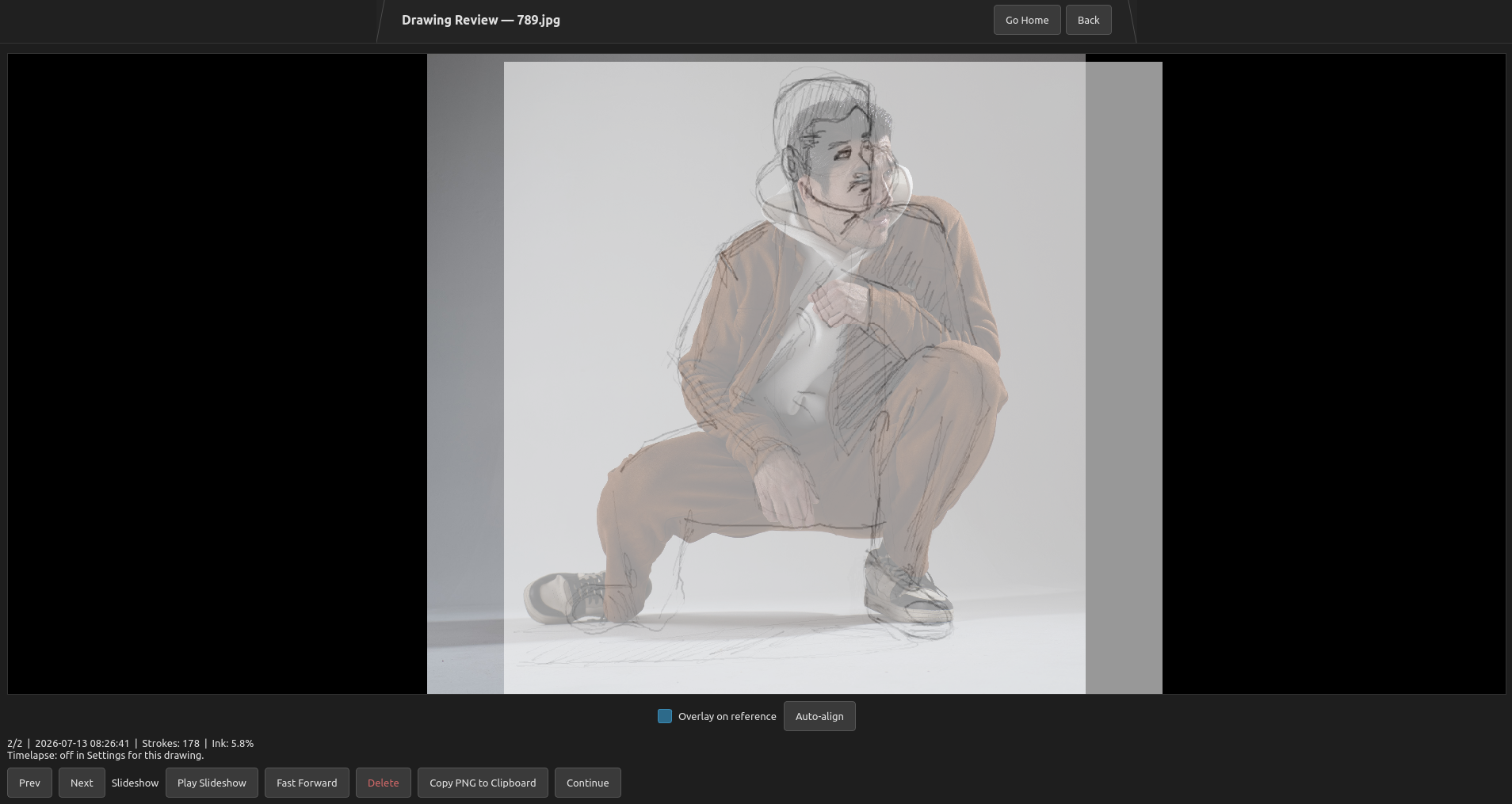
This is what I added to DrawTheDraw. During a drawing session there's an Overlay button. Pressing it swaps the side-by-side view for your current drawing laid over the reference, and you can drag the drawing to line it up; the alignment stays put if you check again later in the same drawing. While the overlay is showing, the canvas is locked, so nothing you click or press can change the drawing. Back to Drawing or Esc puts you straight back where you were, with the drawing, undo history, and session untouched. The timer keeps running while you look, so the check is part of the attempt; Space pauses it if you want to look longer.
It works in regular drawing sessions and in Repeat One Image, where the next attempt at the same reference is right there for the part you got wrong. After the session, the review screen still lets you overlay any saved drawing on its reference.
If you think this kind of tool could help you, have a look — there is a free demo on itch.